
Quick Answer:
Hoya plants thrive best in bright, indirect light for 6 to 12 hours daily. While most varieties prefer a spot near an east or west-facing window, some sun-loving species (like Hoya carnosa) can handle a few hours of soft morning sun, whereas thinner-leafed types (like Hoya linearis) require filtered, dappled light to avoid leaf scorch.
Table of Contents
My Journey into the Light: Why Hoyas are Different
I still remember the first time I brought home a Hoya carnosa compacta—the famous “Hindu Rope.” I tucked it away on a shelf in a cozy, dim corner of my living room, thinking it would be as low-maintenance as a plastic succulent. Six months later, it hadn’t grown a single inch. In fact, it looked tired, dusty, and utterly stagnant.
That was my “lightbulb moment.” I realized that while Hoyas are marketed as easy-going, their relationship with the sun is deeply nuanced. They aren’t just “low light” plants; they are light-seekers that have evolved in the canopies of tropical forests. To see them truly thrive—and to get those incredible, porcelain-like flowers—you have to master the hoya plant light intensity.
Through years of trial, error, and a few scorched leaves, I’ve learned that finding the best light for hoya plants isn’t about following a rigid rule. It’s about learning to read the leaves.
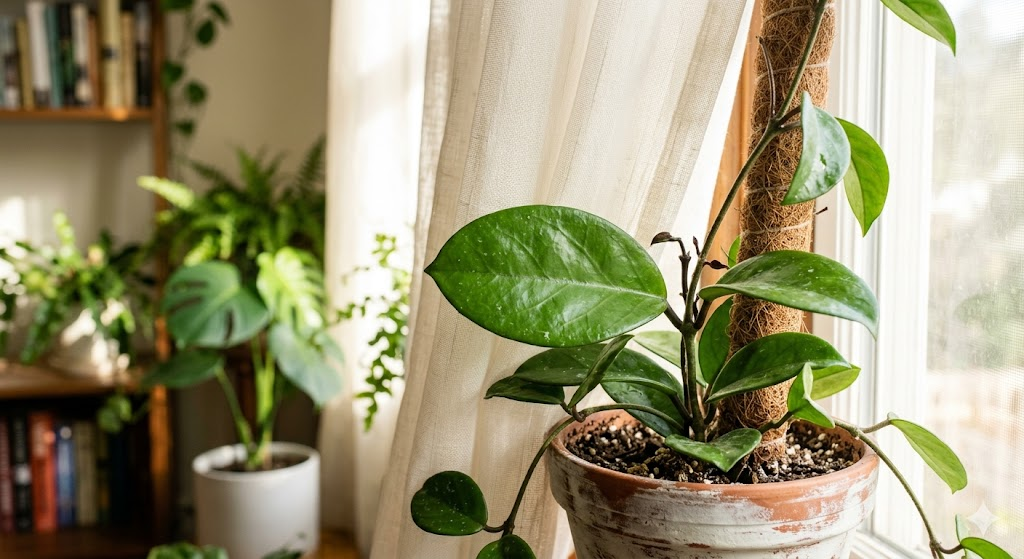
Understanding Hoya Plant Light Intensity
When we talk about light, we often use vague terms like “bright.” But for a Hoya, the difference between “bright” and “burning” is a matter of a few inches.
In their native habitats throughout Southeast Asia and Australia, Hoyas live as epiphytes. They climb trees, basking in hoya plant indirect light that filters through the leaves above. In our homes, we have to mimic that “dappled” effect.
The Sun’s Daily Rhythm
The hoya plant light duration is just as important as the strength of the light. In my experience, Hoyas need a consistent 10 to 12 hours of light to maintain their metabolic health. If you live in a northern climate with short winter days, your Hoya might enter a semi-dormant state. I noticed my Hoya pubicalyx would stop producing its signature purple-flecked leaves every November until I started supplementing with hoya plant artificial light.
The Spectrum of Success
If you want blooms, you need to pay attention to the hoya plant light spectrum. Blue light helps with leafy growth, but red light is the secret sauce for flowering. When I finally switched to a full-spectrum setup, my “stubborn” plants suddenly started putting out peduncles (the little spurs where flowers grow).
Best Window for Hoya Plants: A Directional Guide
Not all windows are created equal. Depending on which way your house faces, the best window for hoya plants will vary.
1. The East-Facing Window (The Sweet Spot)
This is my personal favorite. It provides gentle morning sun that isn’t intense enough to cause hoya plant light stress. I keep my Hoya kerrii here, and the thick, heart-shaped leaves stay a vibrant, deep green without any yellowing.
2. The West-Facing Window (The Danger Zone)
West windows get that “late afternoon heat.” I learned the hard way that putting a Hoya linearis here is a recipe for disaster. Its thin, needle-like leaves dried out and turned crispy within a week. If you use a west window, move the plant three feet back or use a sheer curtain to create hoya plant bright light without the direct heat.
3. The South-Facing Window (The Powerhouse)
The best light for hoya carnosa and other succulent-leafed varieties often comes from a south window. These plants can handle higher intensity. However, keep an eye out for “sun-stressing”—a phenomenon where leaves turn red or bronze. Some collectors love this look, but it’s a sign the plant is at its limit.
4. The North-Facing Window (The Slow Lane)
North windows generally offer hoya plant shade tolerance. While your Hoya will survive here, it likely won’t grow quickly or bloom. If this is your only option, you’ll definitely want to look into the best grow light for hoya plants.
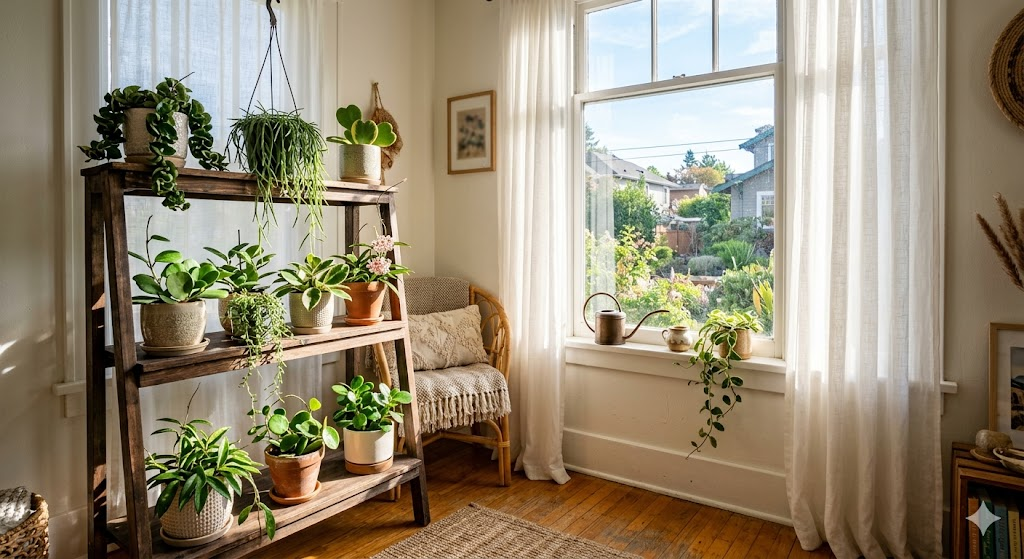
Species-Specific Light Needs: Not All Hoyas Are Equal
One of the biggest mistakes I made early on was treating every Hoya the same. But with hundreds of species, their needs are diverse.
Best Light for Hoya Carnosa & Pubicalyx
These are the workhorses of the Hoya world. They love hoya plant bright light. My Hoya pubicalyx sits right against the glass of an east window and grows like a weed. These varieties have thick, waxy cuticles that protect them from drying out quickly.
Best Light for Hoya Kerrii
The “Sweetheart Hoya” is a bit of a sun worshipper. Because its leaves are so thick and fleshy, it stores a lot of water and can handle more intensity. If it’s kept in too much shade, it’s prone to overwatering because it isn’t “burning through” its water supply fast enough.
Best Light for Hoya Compacta
The Hindu Rope has so many nooks and crannies in its leaves that it’s a magnet for pests if the light is low. High light helps the plant stay robust enough to ward off mealybugs. I found that hoya plant indirect light that is very bright (almost direct) keeps the “ropes” tight and curly.
Best Light for Hoya Linearis
This is the outlier. Unlike its waxy cousins, Hoya linearis is soft and fuzzy. It prefers cooler temperatures and filtered light. Think of it as a “forest floor” plant rather than a “treetop” plant.
Using Artificial Light: When the Sun Isn’t Enough
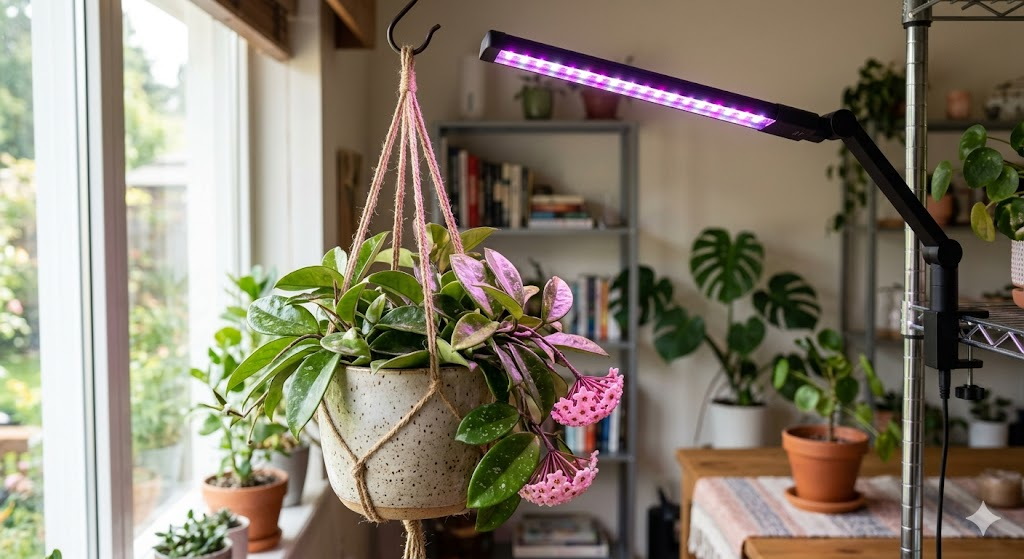
Let’s be honest: not everyone has a perfect sunroom. For years, I lived in a basement apartment with tiny windows. This is where I mastered hoya plant artificial light.
When searching for the best grow light for hoya plants, look for “Full Spectrum LED.”
- Distance: Keep LEDs about 6–12 inches away from the top leaves.
- Duration: Set a timer for 12 hours.
- Intensity: Use a light meter app on your phone. For Hoyas, you’re looking for 1,000 to 2,000 foot-candles for optimal growth.
I noticed that under artificial light, my Hoyas grew more “compact.” The internodes (the space between leaves) were shorter, making the plant look much fuller.
Signs of Light Stress: Troubleshooting Your Hoya
Your Hoya will tell you if it’s unhappy; you just have to know what to look for.
| Symptom | Cause | Fix |
| Yellowing Leaves | Too much direct sun (Chlorosis) | Move 2 feet back from the window. |
| Long, Leggy Stems | Searching for light (Etiolation) | Increase hoya plant light intensity. |
| Red or Bronze Tint | Hoya plant light stress (Sun-stressing) | Usually okay, but watch for leaf burn. |
| Brown, Crispy Patches | Sunburn | Immediate relocation and trim the dead bits. |
| No Flowers | Insufficient light duration | Add a grow light or move to a brighter window. |
My Failures: The Scorched Kerrii
I once moved my Hoya kerrii outside for a “summer vacation.” I didn’t acclimate it, and within two hours of afternoon sun, the leaves had white, bleached spots. That damage is permanent. The lesson? Always transition your plants slowly—over 7 to 10 days—to higher light levels.
Pro Tips for Maximum “Information Gain”
If you want to go beyond the basics, here are three things most blogs won’t tell you:
- Clean the Leaves: Dust acts like a sunblock. If your Hoya is dusty, it’s only receiving about 50% of the available light. I wipe my leaves once a month with a damp microfiber cloth.
- Rotate Your Pots: Hoyas are phototropic—they grow toward the light. If you don’t rotate the pot a quarter-turn every week, you’ll end up with a lopsided plant.
- The “Hand Shadow” Test: If you aren’t sure if your light is “bright indirect,” hold your hand 12 inches above the plant’s spot. If you see a soft, fuzzy shadow, it’s perfect. If the shadow is sharp and dark, it’s direct sun. If there’s no shadow, it’s too dark.
Seasonal Adjustments: The Hoya Calendar
In the spring and summer, your Hoya is in its “power phase.” This is when it needs the most hoya plant bright light and regular feeding.
In the winter, the sun’s angle changes. You might find that a spot that was “bright indirect” in July is now “dark and cold” in January. I often move my collection closer to the glass in the winter to compensate for the weaker rays. Just make sure the leaves aren’t touching the freezing cold windowpane, as that can cause “cold burn.”
Summary of Hoya Light Requirements
To wrap it up, your goal is to find that “Goldilocks” zone. Not too hot, not too dark, but just right.
- Intensity: 1,000–2,000 foot-candles.
- Duration: 10–12 hours.
- Best Location: East window or 3 feet from a South/West window.
- Artificial Backup: Use full-spectrum LEDs for winter or dark rooms.
Growing Hoyas is a marathon, not a sprint. They are slow-growing, long-lived companions. When you get the light right, they reward you with some of the most fragrant, alien-looking flowers in the botanical world. It took me a few years to stop “guessing” and start “observing,” and I hope this guide helps you skip the guesswork and go straight to the growth.
Frequently Asked Questions
Can a Hoya live in low light?
Technically, yes, it can survive. However, it will likely stop growing, and it will almost certainly never bloom. For a Hoya to thrive, it really needs hoya plant bright light.
How do I know if my grow light is too close?
If the top leaves start to turn yellow or feel unusually warm to the touch, your best grow light for hoya plants is likely too close. Back it off by 6 inches.
Why is my Hoya losing its variegation?
If you have a variegated variety like Hoya carnosa ‘Krimson Queen’, and the new leaves are coming out solid green, it’s a sign of low light. The plant is producing more chlorophyll to survive, sacrificing its white or pink edges.
What is the best light for Hoya linearis compared to others?
Hoya linearis prefers cooler, dappled light. It is much more sensitive to heat and direct sun than the thicker-leafed Hoya pubicalyx or Hoya carnosa.
Should I use a light meter?
If you are serious about your collection, yes. It takes the “human error” out of assessing hoya plant light intensity. You can find affordable ones online or use a free app on your smartphone.
For more information on specific plant care and lighting science, you can explore further on Google Search.